
Frequently asked questions
We’ve developed the following frequently asked questions and scenario examples to help you understand the draft Policy, what it could mean for you and your property, and how to prepare your submission.
Have a question we haven’t answered? Click here to ask us.
About the project
What is Trees on Your Land?
Trees on Your Land is the City’s project looking at how medium and large trees on private land could be retained, removed and replaced.
The project began in 2024 by asking the community whether the City should have a role in managing tree loss on private land. That feedback has informed the draft Local Planning Policy 1.24 – Regulated Trees on Private Land, which is now open for public comment.
What is an urban forest?
An urban forest includes the trees and other vegetation across the City, as well as the soil and water that support them.
It includes trees and vegetation on both public and private land.
Since adopting the Urban Forest Strategy in 2017, our focus has been on managing trees on public land. However, recent analysis shows that we need to take additional steps. Feedback received from our community through the Our Future Melville, Local Planning Scheme 6 review, and the Community Climate Action Plan has highlighted how much our residents value green spaces, trees, and climate action.
What is the City’s current tree canopy cover?
The City’s 2022 tree canopy survey found that tree canopy covered 12.5% of Melville, down from 13.9% in 2016.
Mapping indicates that tree removal associated with development and subdivision is one of the key contributors to this decline.
How much tree canopy is on private land?
The City’s 2022 mapping found that approximately 45% of Melville’s tree canopy was on private land, while 54% was on public land.
This means trees on private land make an important contribution to Melville’s overall tree canopy.
How did the project come about?
The City has been managing and planting trees on public land through its Urban Forest Strategy.
However, the City’s analysis found that planting on available public land alone would not be enough to substantially increase Melville’s overall tree canopy. This highlighted the important contribution of trees on private land.
Tree retention is also supported through the Council Plan 2024–2034 and has been raised through previous community engagement and Council decisions.
About the draft Policy
Why has the City developed a draft policy?
Medium and large trees provide shade, support biodiversity and help make our suburbs cooler, greener and more liveable. However, tree canopy is declining, particularly on private land. The draft policy seeks to balance tree retention with appropriate development and the practical use of private property.
Is the draft Policy final?
No. The policy is still in draft form and its proposed requirements are not currently in effect.Feedback received during the consultation will be reviewed before the draft policy is presented to Council.
Until a policy is formally adopted, the current planning framework remains in place. This means development approval is not currently required to remove a tree on private land.
Who is the decision maker?
The City of Melville Council is the final decision-maker.
What is a local planning policy?
A local planning policy guides how the City assesses and makes decisions about planning matters.
The draft Policy proposes criteria for identifying regulated trees and guidance for assessing applications to remove or significantly damage those trees.
What is a regulated tree?
Under the draft Policy, a regulated tree would generally be a living tree that meets the proposed size criteria.
These criteria relate to:
- Height of the tree
- Diameter of its canopy
- Circumference of its trunk
Refer to the draft policy for the complete definition and measurement requirements.
Does the draft Policy apply to every tree?
No. It focuses on medium and large trees that meet the proposed regulated-tree criteria. Some tree types, activities and circumstances may be exempt.
Does the draft Policy ban tree removal?
No. The draft Policy does not ban tree removal. It proposes a process for assessing the removal of, or significant damage to, some regulated trees. Removal may be supported where retaining the tree is not reasonable or practical.
Does the draft Policy only apply to residential properties?
No. The draft policy is proposed to apply to all zoned land under Local Planning Scheme No. 6.
This includes residential, commercial and other privately owned land.
What about subdivision?
The Western Australian Planning Commission (WAPC) approves subdivision. Applications are referred to the City for comment and proposes conditions of approval. If the policy is adopted, the City will assess tree retention and/or replacement as part of referral process and would recommend conditions e.g. tree retention. However, the WAPC is the final approver of the subdivision.
Will it apply to street trees and trees in parks?
No. The draft Policy relates to regulated trees on private land. Street trees, park trees and trees on other City-managed land are managed through separate processes.
Do I currently need approval to prune or remove a tree?
The draft Policy has not been adopted and its proposed requirements are not currently in effect.
Until the City of Melville Council makes a final decision, the existing planning requirements continue to apply. Contact the City before undertaking work if you are unsure whether another approval or requirement applies.
Scenario examples
How could the draft Policy work?
The examples below show how the draft Policy could apply to common, real-life situations if it is adopted by Council.
They are designed to help you understand what is being proposed, how it could affect you and prepare an informed submission.
Tree Pruning
Example
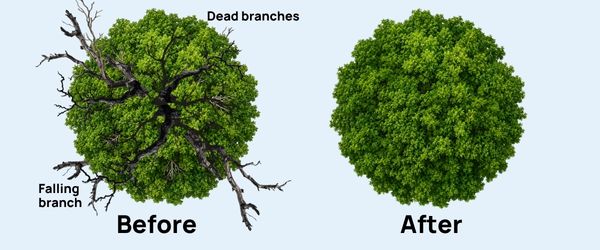
A tree in a backyard is 8 metres high and has a 6 metre canopy. It has several dead branches and one large branch that may fall.
What can the owner do?
The owner can remove the dead and hazardous branches as maintenance pruning, provided the work:
- does not substantially reduce the canopy
- does not affect the tree’s health, structure or long-term survival.
Outcome
✅No development approval required
✅Hazardous branches removed
✅Tree and canopy retained
✅Tree remains healthy
Building a new home while retaining a tree
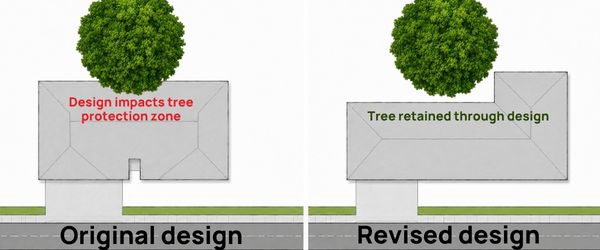
A regulated tree is located where the owner wants to build a new home. The original house and driveway design would encroach into the tree protection zone and could damage the tree.
What can the owner do?
The owner can revise the design by moving or changing the house and driveway so they avoid or minimise impacts on the tree protection zone.
The development application should show:
- the location of the regulated tree
- the tree protection zone
- how the tree will be retained and protected
- any proposed works within or near the tree protection zone.
Outcome
✅Revised design avoids or minimises impacts on the tree
✅Tree and canopy retained
✅Development can still occur
✅Revised proposal can proceed through the development assessment process
House extension requiring tree removal
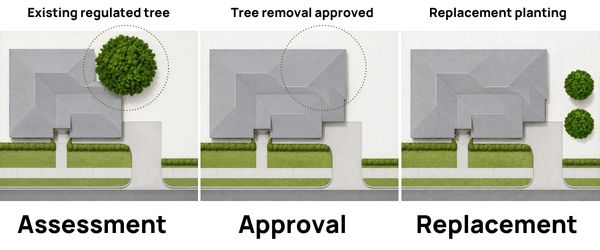
An owner wants to extend their home, but a large regulated tree is located within the proposed building area. An arborist and planning assessment finds that the tree cannot reasonably be retained and redesigning the extension is not practical.
What can the owner do?
The owner can lodge a development application seeking approval to remove the regulated tree. The application should include:
- an arborist report
- the location and condition of the tree
- evidence that alternative designs were considered
- reasons the tree cannot reasonably be retained
- details of the proposed replacement planting.
Outcome
If the removal is approved:
- The regulated tree can be removed
- The approved house extension can proceed ✅
- Replacement trees must be planted on the property
- The new trees will help restore future canopy cover ✅
Building a new home where a tree cannot be retained
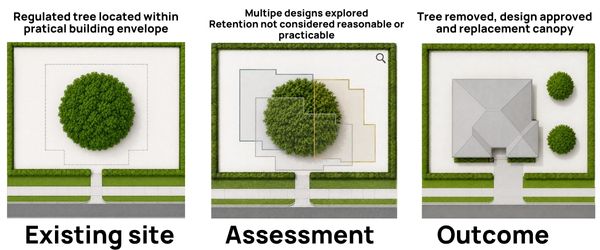
A regulated tree is located within the only practical building area on a residential lot. Different house designs have been considered, but an arborist and planning assessment finds that retaining the tree is not reasonable or practical.
What can the owner do?
The owner can lodge a development application seeking approval to remove the regulated tree. The application should include:
- an arborist report
- the location and condition of the tree
- evidence that alternative designs were considered
- reasons the tree cannot reasonably be retained
- details of proposed replacement planting.
Outcome
If the removal is approved:
- The regulated tree can be removed
- The new home can be built, subject to development approval ✅
- Replacement trees must be planted on the property
- The new trees will help restore future canopy cover ✅
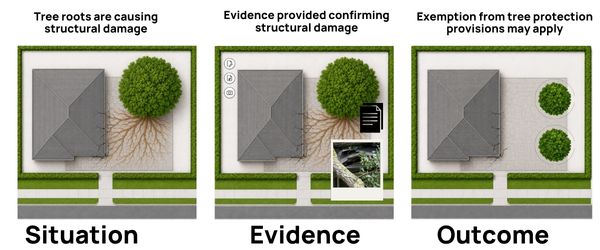
Tree causing structural damage
A regulated tree is growing beside a home. Cracking has appeared in the dwelling, and there is evidence that the tree’s roots may be causing structural damage.
What can the owner do?
The owner must contact the City and request written planning advice before removing or damaging the tree. Supporting evidence may include:
- photographs of the damage and tree
- an engineering report confirming the cause of the structural damage
- an arborist report explaining the tree’s condition and whether pruning or root management could resolve the issue
- a site plan showing the tree, dwelling and affected area.
Outcome
If the City is satisfied that:
- The tree is causing structural damage to the dwelling
- The damage cannot reasonably be managed through pruning or other treatment
- Sufficient supporting evidence has been provided
The City may confirm that development approval is not required for the proposed tree work or removal.
Important: This exemption cannot be self-assessed. Written confirmation must be obtained from the City of Melville before starting work. Other approvals or legal requirements may still apply.
Engagement and feedback
What has the community already told us?
In 2024, 918 people took part in the Trees on Your Land engagement and shared their views on tree loss on private land and the roles of landowners, the community and the City.
The feedback showed a range of views about whether and how the City should regulate trees on private property. While 63.2% of participants supported developing a Local Planning Policy focused on retaining trees, others raised concerns about property rights, costs and the practical impacts of regulation.
Key themes included:
- preserving large, mature trees for shade, wildlife habitat and neighbourhood character
- balancing tree retention with development and property rights
- mixed views about approvals, regulation and enforcement
- providing landowners with education, advice, incentives and financial assistance
- requiring replacement planting or compensation when large trees are removed
- taking a collaborative approach with landowners
- ensuring the City demonstrates consistent tree management on public land.
This feedback was presented to Council and helped inform the development of the draft policy.
How can I share my feedback on the draft Policy?
We want our engagement process to be accessible by all. In addition to the online submission form, you can share your feedback by contacting us:
- Over the phone, 9364 0666
- In person, at the City of Melville Administration Building located at 10 Almondbury Road, Booragoon WA
- In writing by downloading the submission form or By letter to: Chief Executive Officer, City of Melville, Locked Bag 1, Booragoon WA 6954
Please note: only one voting submission per person will be accepted. Duplicate submissions will be removed in line with procurement requirements.
What happens after consultation closes?
The City will review all submissions and identify the key themes, concerns and suggested changes.
A report will then be prepared for Council. Council may decide to adopt, amend, defer or not proceed with the draft policy.
How are the community and submitters informed of the outcome of this proposal?
All submitters and registered page followers will be notified of the outcome via direct email. Outcomes will also be published on the City’s website.
How to make a good submission
Community feedback helps us understand different perspectives and potential impacts. When preparing your submission:
- Start early and review the project information.
- Be informed by reading the FAQs and seek clarification if needed.
- Focus on facts and clearly explain your views.
- Describe how the proposal may affect you or your community.
- Submit one clear response before the closing date.
Each person is permitted to lodge one submission only. Any duplicate submissions may be excluded from consideration.
My relative is not confident using technology. Can I complete the submissions form on their behalf?
Yes. You may assist someone to complete a submission on their behalf, provided you have their consent. Alternative ways to participate are also available. Feedback can be provided online, by phone, or in person, and the City of Melville can assist if required.
Why are you asking for identifiable information in the submission form?
We ask for basic details such as your name or suburb to help ensure feedback is genuine, understand who we’ve reached, and improve future engagement.
Privacy Collection Statement
This collection notice sets out how the City of Melville will manage your personal information.
We will handle any personal information you provide in accordance with the standards set out in the Privacy and Responsible Information Sharing Act 2024 (PRIS Act).
The City of Melville collects personal information about yourself for the purposes of identification and/or administering your request. This includes your full name, demographic details such as your age, residential address, contact details and other information relevant to your request. Some forms also collect sensitive information such as health information, when necessary for completing a service. If you choose not to provide this information, we may be unable to assist with your request.
The information you provide will only be used for the purpose you have provided it. Any queries regarding access or correction to your personal information can be directed to our Privacy Officer through privacy@melville.wa.gov.au.
For full information about how we handle your personal information, visit the below webpage.