
Project information
The Master Plan objectives include:
- Articulating a clear vision for the site that can be used to develop scenarios and guide future direction for the study area
- Engaging with the community and key stakeholders to ensure the future vision is informed and shaped by the community
- Increasing and improving the usable public open space and active sporting areas, whilst preserving natural spaces for all to enjoy
- Improving access to and through the site, including parking considerations
- Protecting and enhancing reserve biodiversity
- Celebrating First Nations' history and values
- Exploring long-term remediation of the former landfill site
- Establishing an exemplar model for remediation and recreation development
- Guiding future decision-making for the next 20 years.
To guide the preparation of the Master Plan and bring together the values and aspirations of both stakeholders and community, a Design and Place Principles Framework was developed.
Vision for the site
Create a John Connell Reserve that champions safe, sustainable use of the land, nurtures the environment and provides for diverse community and recreational needs through inclusive design and adaptive management.
A Master Plan is a dynamic long-term strategic document that provides overarching guidance and coordination for the future of an area.
The Master Plan establishes a framework and key principles that align with good practice and outcomes for the site, in line with the shared values identified by the project team and stakeholders. It will not determine the merit of proposals themselves or provide a decision-making function as it is not a statutory document.
The Master Plan will ultimately guide the manner in which the John Connell Reserve area will evolve, and be used as a basis for more detailed planning and funding decisions
The City of Melville Council will make the final decision regarding endorsement of the Master Plan.
The City has funded the preparation of the Master Plan. The implementation of recommendations and priority projects, including funding allocation arising from the master plan, will be a future decision for the City of Melville Council.
In February 2021, Council unanimously resolved the following:
- Authorises the Chief Executive Officer to notify Development WA that the City intends to no longer proceed with the Memorandum of Understanding for the John Connell Reserve Redevelopment Project.
- Authorises the Chief Executive Officer to write to Melville Glades Golf Club advising of the Council decision.
- Notes the improvement projects put forward for the John Connell Reserve at the request of the stakeholders being, the upgrade to the present change rooms, relocation and replacement of the practice cricket nets, and the construction of additional parking, be brought forward for consideration in the event that external funding to cover these costs is secured.
- Brings forward the preparation of the Master Plan for the entire 122 hectare John Connell Reserve for consideration in the 2021-2022 budget.
On Tuesday June 22, 2021, Council adopted the 2021-22 financial year budget, which included funds to carry out the John Connell Reserve Master Plan.
Yes, continued use of existing sports will be preserved in the final Master Plan.
The Master Plan may consider shared use or relocation of facilities within the reserve where appropriate.
This Master Plan has not considered any changes to the location or course layout (including holes) at the Melville Glades Golf Club. This Master Plan has not considered any changes to the location or course layout (including holes) at the Melville Glades Golf Club.
Site information
The John Connell and Melville Glades Reserves comprise of 122 hectares of important public open space in the eastern part of the City of Melville. They provide significant environmental, passive and active recreational opportunities for the local and regional community.
Part of the John Connell Reserve was previously the site of the Dundee Road Landfill, which operated from 1974 to 2000 and includes areas currently occupied by the Bowmen of Melville (Archery), Amalgamated Melville Homing Club (homing pigeons), public park area, and the Melville Golf Centre.
The last stage of the landfill occurred on the southwestern corner of the reserve, which resulted in a final landform level representing the highest part of the elevated area being 41 metres above sea level.
The site is classified as “contaminated – remediation required” by the Department of Water and Environment Regulation in accordance with the Contaminated Sites Act 2003.
Leeming Bowls and Recreation Club Inc, Leeming Strikers Football Club, Leeming Spartans Cricket Club, Leeming Spartans Junior Cricket Club and the Leeming Sporting Association Inc. are also located on the site. The Melville Glades Golf Club (18-hole private golf course) is located on the Melville Glades Reserve within the project site.
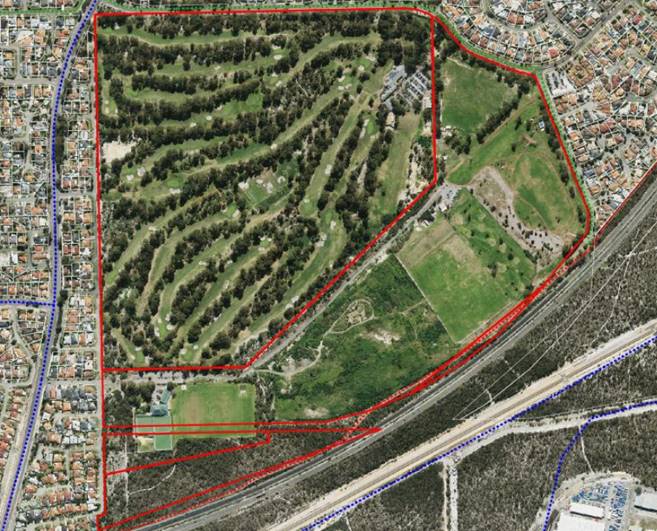
This Master Plan has not considered residential development anywhere on the site, or changes to the holes/course layout at the Melville Glades Golf Club, unlike the previous planning project.
An earlier draft concept plan (including residential development) was prepared and presented to Council in 2019 for informal feedback prior to embarking on a community consultation process.
In October 2019, Council elections resulted in the then Council expressing its opposition to proceeding with the residential development project. The City had a Memorandum of Understanding with DevelopmentWA (formerly LandCorp) regarding the previous development project. As per the Council resolution in February 2021, the City advised it no longer intended to proceed with the agreement. As a result, the John Connell Reserve Redevelopment Project was abandoned.
Appropriate commercial development that is complementary and aligns with the core uses and functions of the site may be considered.
Any inappropriate commercial development is excluded from consideration of the Master Plan.
The Master Plan has been designed to encourage a net increase in canopy cover.
Consideration will be given with any development of recreational spaces to minimise additional pressure on existing endangered vegetation communities, habitat, and resources. The master plan will aim to provide a restorative landscape that delivers greater environmental value.
The site has a varied history, including a portion previously being used as landfill for 26 years, with much of it requiring remediation as shown on the map below. The contamination ranges in depth across the site, and soil capping is very thin (<0.5m – to none at surface). The contamination is largely construction and domestic waste, asbestos containing materials and soil leachate (heavy metals).
There is a need to remediate part of the site as per the Contaminated Sites Act 2003, and it is unlikely new development of the contaminated areas will be authorised unless some remedial work is completed. It also may affect the standard of buildings required in the future (i.e. specific footings, stabilisation work) and how groundwater may be used. The ability for vegetation to re-establish on landfill areas is currently unknown, and it may not be successful beyond the embankments, until further studies are completed.
Whilst the entire parcel of land shown in the map below is classified as contaminated, not all of this area has contaminated material in it. This relates only to the previous landfill site as shown on the map. The native bushland (Banksia Woodland) areas, adjacent playing fields and facilities do not require remediation.
A recommendation from this master planning process is to continue with some immediate investigations to help answer some of the questions about how the contamination is best remediated. These studies include (but are not limited to):
- Geotechnical studies – compaction and test of material for future use
- Investigations of additional piles of construction material (post 2013)
- Nature and extent of older/current capping (is it still viable)
- Groundwater testing / monitoring sampling (3-5 years) – particularly for driving range groundwater abstraction
- Water quality data from existing bore (onsite)
- Asbestos Management Plan pre any work on the landfill areas
- Update Site Management Plan (presently and ongoing)
- Landfill gas assessments for structures/buildings on landfill areas (12-24 months)
- Health risk assessments.
We are sharing this information to help you understand some of the complexities with redeveloping this site and that further work needs to be done, which will take time and cost. The cost of remediation is also unknown to some extent, until some of these investigations are completed.
In June 2023, the Leeming Spartan Cricket Club lodged a clearing permit application with the Department of Water and Environmental Regulation (DWER) for a strip of bushland east of the cricket oval. The application has since been approved by DWER in July 2025.
As the land manager, the City of Melville Council granted permission for the Club to submit the clearing application. While DWER is the approving authority for clearing permits, the proposed oval extension itself has not been approved, and will require further detailed design, cost estimates and a consideration by Council before any decision is made.
Community engagement
Community engagement was undertaken to understand how people currently use John Connell Reserve, what they value most and their aspirations for its future. Feedback helped inform the development of the Master Plan, ensuring it reflects a broad range of community needs, values and ideas.
The City undertook a multi-stage engagement process over several years. Engagement activities included:
- Community vision surveys
- Scenario surveys
- Pop-up engagement sessions
- Workshops
- One-on-one stakeholder conversations
- Youth engagement activities
- Consultation with First Nations Elders
- The John Connell Collective community reference group
Each stage built on previous feedback to help refine the Master Plan.
The Vision Survey was the first stage of engagement and asked the community how they currently use the reserve, what they value most and what they would like to see in the future. The results helped establish the guiding principles and early concepts for the Master Plan.
The Scenarios Survey invited the community to explore a range of possible futures for John Connell Reserve. Participants shared their preferences and priorities, helping the project team understand which ideas were most supported and what considerations should inform the Master Plan.
The John Connell Collective was a community reference group established to provide ongoing feedback throughout the planning process. The group represented a diverse cross-section of the community and helped review ideas, test concepts and provide local perspectives as the Master Plan evolved.
Community members were invited to submit an Expression of Interest to join the John Connell Collective. Participants were selected using a blind assessment process to achieve a diverse mix of ages, backgrounds, interests, locations and perspectives that reflected the broader community.
The City engaged with a broad range of stakeholders throughout the project, including sporting clubs, community organisations, government agencies, environmental groups and other key stakeholders with an interest in the future of the reserve.
Young people played an important role in shaping the Master Plan. Students from local schools participated in interactive classroom activities where they shared ideas, aspirations and priorities for the future of John Connell Reserve.
The City worked alongside First Nations Elders through workshops and site visits to better understand the cultural significance of John Connell Reserve. Their knowledge helped identify opportunities to recognise Aboriginal culture, celebrate connection to Country and incorporate cultural values into the Master Plan.
Feedback collected throughout each stage of engagement helped shape the Master Plan by identifying community priorities, testing ideas, refining concepts and ensuring the plan considered a broad range of community values and aspirations.
Community engagement for the Master Plan has now concluded. The City undertook extensive consultation across multiple stages to gather feedback and inform the development of the Master Plan. There are currently no opportunities to provide feedback.
Community engagement summaries, reports and supporting information are available in the Document Library on the main project page. These documents outline what the community told us and how that feedback has informed the Master Plan.
Field Extension
Everything you need to know about the John Connell Reserve Field Extension.